

Overview
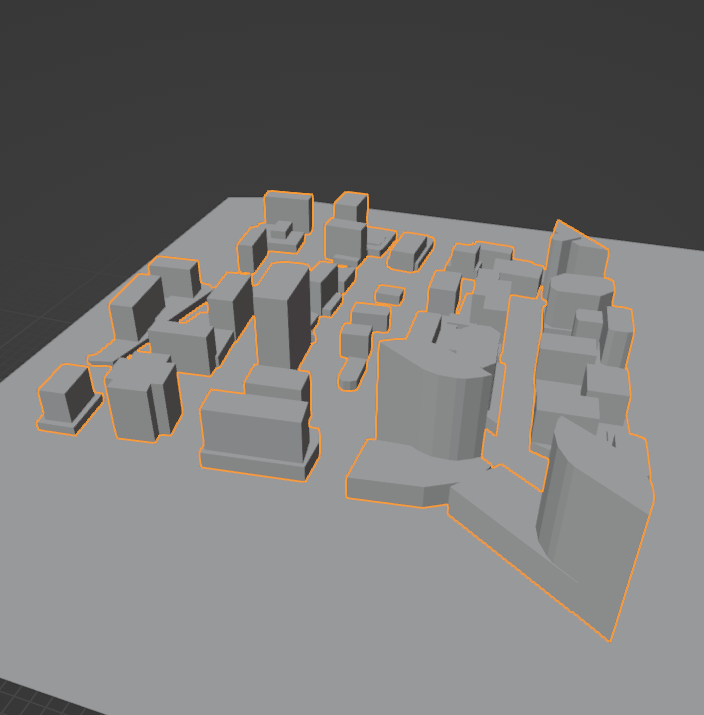
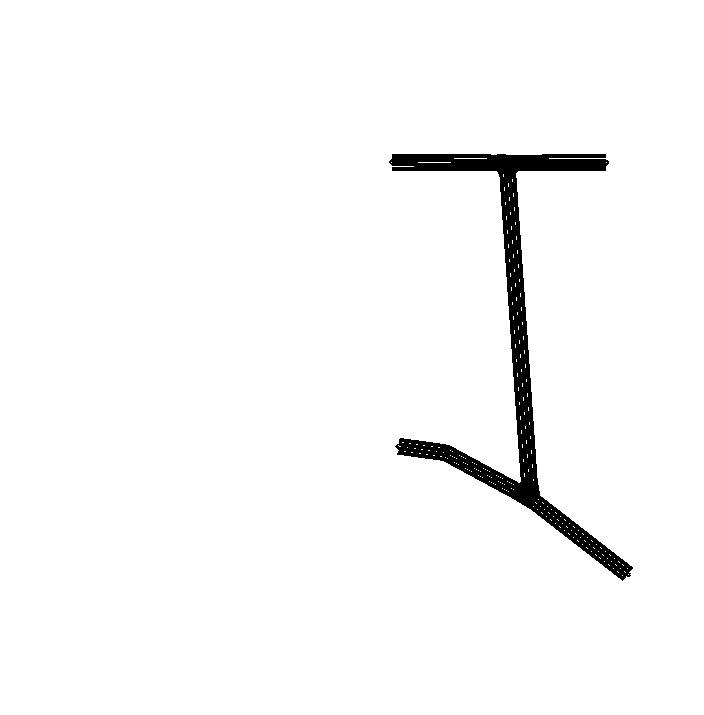
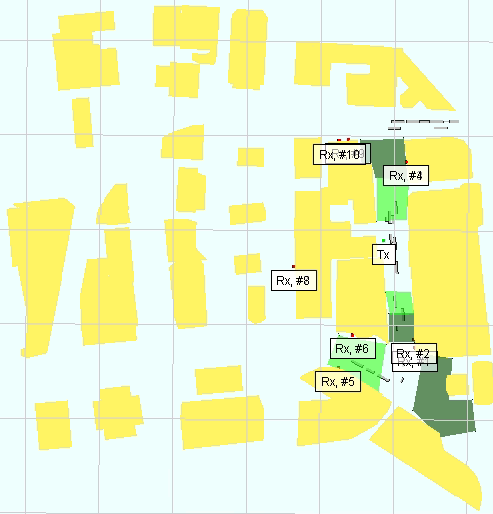
Scenario 2 is a synthetic street-level urban canyon scenario with mobile vehicles, ray-traced channels at 2.8; 5 GHz (2 versions). In this scenario, the base station antenna is positioned at 4m height from the surface making the link more vulnerable to dynamic blockages (buses, trucks) and cornering. Rosslyn urban scenario is configured in 2.8; 5 GHz (2 versions), with 200 episodes of 10 scenes each, time between scenes of 5ms, time between episodes of 37s, 10 fixed receivers and 1 fixed transmitter. The images 1-3 show the 3D meshes of scenario in blender, the SUMO view of maped street where the vehicles realize their routs, the top view of scenario (constructions in yellow, sparce foliage in light green, dense foliage in dark green, ground in baby blue, receivers in red, transmitter in green) at Wireless Insite, respectively.
Rosslyn Avenue
Rosslyn Avenue (Arlington, VA – Approx. Lat/Long: 38.8950° N, 77.0715° W)is located in the dense urban core of Rosslyn, Arlington, VA, forming part of a grid of narrow streets surrounded by mid- and high-rise buildings. The modeled portion of the avenue in this scenario is a two-way urban street with no marked lanes (common in narrower segments of the Rosslyn district). The effective road width is approximately 8–10 meters, supporting slow, mixed traffic flow. The typical speed limit ranges from 25 to 30 mph (≈ 40–48 km/h), characteristic of urban business districts with frequent intersections and pedestrian activity. Traffic is composed of cars, SUVs, delivery vans, buses, and occasional trucks, all of which introduce diverse mobility patterns and dynamic blockages. From a wireless communication perspective, the absence of lane markings, combined with the narrow street geometry and tall surrounding buildings, produces a pronounced urban canyon effect. Vehicles moving close to the base station line-of-sight can create partial or complete blockages, while buildings generate significant multipath via reflections and diffractions. These characteristics make Rosslyn Avenue a challenging and representative environment for evaluating beam tracking, blockage prediction, and mmWave/6G communication robustness.
Collected Data
The collected data was obtained by simulating traffic at Simulator of Urban Mobility (SUMO) and orchestrating placement and raytracing simulation at wireless Insite (WI) through the python orchestrator Raymobtime. The data collected is described as follows.
1. Ray tracing data: top 100 rays of highest received power, obtained from Wireless Insite (WI).
- Received power, time of arrival, elevation angle of departure, azimuth angle of departure, elevation angle of arrival, azimuth angle of arrival, LOS condition.
- Type data: .hdf5 of each episode
- Processed RUN’s folder: Contains all simulated sampples at Wireless Insite.
Data Visualization
Dataset details
| 3D scenario | Rosslyn |
| Frequency | 2.8; 5 GHz |
| Number of receivers and type | 10 Fixed |
| Number of episodes | 200 |
| Number of scenes per episode | 10 |
| Time between scenes | 5 ms |
| Time between episodes | 37s |
| Number of runs | 2000 |
| Number of valid channels | 20K |
Simulation details
- Traffic parameters (Simulator of Urban Mobility)
| Number of lanes | 4 |
| Vehicles | Car, Truck, Bus |
| Lengths, respectively (m) | 4.645, 12.5, 9.0 |
| Heights, respectively (m) | 1.59, 4.3, 3.2 |
| Probabilities, respectively (m) | 0.7, 0.1, 0.2 |
| acceleration, respectively (m/s2) | 3, 2, 2 |
| deceleration, respectively (m/s2) | 4.5, 4, 4 |
| Max vehicles speed (m/s) | 17.8 |
| Average speed (m/s) | 8.2 |
| Sampling period (s) | 0.005 |
- Elements and materials (WI)
| Elements | Material |
| Buildings | ITU Concrete 2.8; 5 GHz |
| Ground | ITU Concrete 2.8; 5 GHz |
| Vehicles | PEC Metal |
| Sparce Foliage | Sparce Diciduous Forest, in leaf |
| Dense Foliage | Dense Deciduos Forest, in leaf |
- Transmitter details (WI)
| Number and type | 1 Fixed |
| Antenna type | Isotropic |
| Polarization | Vertical |
| Input power | 0 dbm |
| Position (x,y,z) (m) | 746.0, 560.0, 4.0 |
- Receiver details (WI)
| Number and type | 10 Fixed |
| Plataform type | None |
| Antenna type | Isotropic |
| Polarization | Vertical |
| Noise figure | 3 dbm |
| Position (x,y,z) (m) | Rx1 (777, 455, 3) Rx2 (776, 463, 3) Rx3 (768, 637, 3) Rx4 (768 , 637, 10) Rx5 (702, 435, 3) Rx6 (716, 467, 3) Rx7 (658, 534, 3) Rx8 (658, 534,9) Rx9 (711, 659, 3) Rx10 (702, 658, 3) |
- Ray tracing configuration (WI)
| Propagation model | X3D |
| Number of reflections | 6 |
| Number of transmissions | 0 |
| Number of diffractions | 1 |
| Number of rays | 100 |
| Ray spacing | 1° |
- Diffuse Scattering configuration (WI)
| Diffuse scattering | Disabled |
- Signal Information (WI)
| Signal type | Sinusoid |
| Frequency | 2.8; 5 GHz |
| Bandwidth | 1 MHz |
Wireless Insite:
– The Rosslyn scenario used at simulations corresponds to a 3D model that is part of Wireless insite examples.
– The RT area of study is a rectangle of approximately 337 × 202 m2.
– The simulation was realized at wireless insite 3.2
– The 3D models used at Wirelless insite for vehicles were boxes seted to vehicles dimentions.
Download & Citation
If you want to use the dataset or scripts on this page, please use the link below to generate the final list of papers that need to be cited.
Files and folders explanation
📁 1. s001_Rosslyn_10FixedRx_(N)GHz_200episodes_10scenes_Ts5ms_InSite3.2.tar.gz — Processed Runs
The folder includes the base wireless insite simulation that was used to setup the sampples of scenes of each episode. The numeration of each one is according to the sampple Eg:
– run00000 = episode 1, scene 1
– run00023 = episode 3, scene 3
At study folder inside each run there are p2m files of simulated outputs. They include:
– Complex impulse response;
– Path loss/gain;
– Propagation paths;
– Received power.
📁 2. ray_tracing_data_s001_carrier(N)GHz.zip — Rays Information (HDF5)
The ray-traced data is stored in HDF5 format using a four-dimensional structure (Each episode has own HDF5 file):
Structure:
AllEpisodeData[number of scenes, number of TX–RX pairs, maximum number of rays, number of stored parameters]
Each ray contains:
- Received power (dBm)
- Time of arrival (seconds)
- Elevation angle of departure (degrees)
- Azimuth angle of departure (degrees)
- Elevation angle of arrival (degrees)
- Azimuth angle of arrival (degrees)
- LOS flag: 1 = LOS, 0 = NLOS
- Ray phase (degrees)
This data enables high-fidelity reconstruction of multipath behavior, reflections, diffractions, and critical LOS/NLOS transitions.
📁 3. documentation/ — README and Citation Information
This folder contains:
- Dataset README
- License and usage rules
- Citation generator references
- Links to related academic papers
- Change logs or updates